
How Much Do Movers Cost? 9 Factors That Shape the Price
Sat, 24 Oct 2026

Follow the stories of academics and their research expeditions
Review scope: pricing and specifications are treated as a provider-published snapshot. Confirm the live checkout and current terms before ordering. Long-term performance figures are not claimed unless independently measured.
Official service: ProxyLine official English website

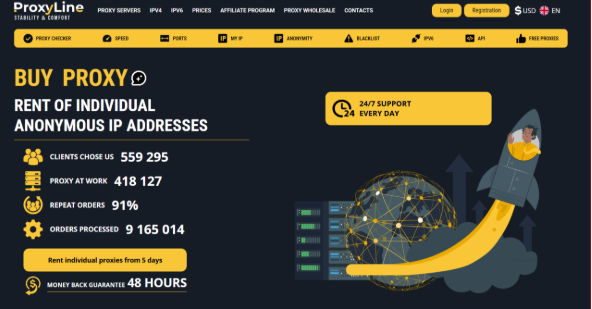
ProxyLine website screenshot used as visual context.
For this ProxyLine review I approached the service from the perspective of an operator who needs the same provider for three common jobs: browser automation, SEO research and public-data collection. Those workloads overlap, but they are not identical. Browser profiles often need a stable exit IP and predictable session behavior. SEO tools need repeatable geographic checks and clean inventory management. Data collection adds concurrency, retry logic and cost pressure. The useful question is therefore not simply whether ProxyLine sells proxies; it is whether its fixed-proxy catalogue is flexible enough to map cleanly to those different operating models.
I treated the provider-published catalogue as the source for plan structure and pricing, then evaluated how I would actually deploy the available proxy types. I did not run a long-duration latency benchmark or claim a measured uptime percentage. Instead, I focused on configuration fit, protocol choices, scaling discipline and the failure points that usually appear when teams move from a handful of manual sessions to repeatable automation.
For browser automation, my first preference is an individual IPv4 address rather than a shared address. The reason is operational control. When a browser profile is tied to one fixed IP, it is easier to keep sessions consistent, reproduce login behavior and diagnose a problem. Shared IPv4 can be useful for cheaper, low-risk browsing, but another customer can influence the reputation of the same exit address. That makes shared IPs a weaker default when a profile is expected to persist for days or weeks.
I would assign one proxy to one browser profile, record the country and rental expiry, and avoid moving the same credentials between unrelated profiles. In anti-detect browsers or ordinary profile managers, the important check is not just whether a connection succeeds. I also verify the visible IP, geolocation, DNS behavior and whether the target site delivers the expected regional version. SOCKS5 is useful when the application needs broader TCP handling; HTTP(S) is often enough for browser-oriented tasks. The important part is consistency: use one protocol policy per workflow instead of letting every operator configure endpoints differently.
SEO research changes the buying logic. A rank checker, redirect auditor or localization workflow may care more about country coverage and repeatability than about a long-lived browser identity. Here, a small pool of dedicated IPv4 addresses can provide a cleaner baseline because each market can be assigned to a known endpoint. If the project only needs occasional public checks, shared IPv4 may be acceptable and can reduce cost.
The biggest SEO mistake is assuming that a country label guarantees the exact result you want. Search engines and websites can react to city, ASN, language, account state, cookies and device signals as well as IP country. I therefore treat a proxy as one input in a geographic test, not as the entire test. My standard procedure is to use a clean browser state, verify the exit country, repeat the same query through more than one IP and record unexpected redirects or language changes. If city-level accuracy is essential, I would confirm the available inventory before committing to a large order.
Public-data collection introduces scale. A few manually managed endpoints can turn into dozens of addresses, and the operational burden grows quickly. ProxyLine's lower-cost fixed options are attractive here because a team can build a pool without paying rotating-residential prices. But fixed proxies need disciplined assignment. I keep an inventory table with proxy ID, type, country, project, start date, renewal date, status and recent error notes.
Retries also matter. An automation script should distinguish between an application error, target rate limit, authentication failure and proxy connectivity problem. Blindly retrying every failure can create more blocks and make troubleshooting harder. I prefer modest concurrency, randomized scheduling where appropriate, clear per-target rate limits and logs that show which proxy was used for each request. If a destination publishes an API or robots guidance, the collection workflow should respect those rules.
Plan / type | Pricing snapshot | Rental term | Best fit |
IPv4 Shared | about $0.58-$0.99 per IP/month | 5-360 days | Budget research and low-risk public-data tasks |
Individual IPv4 | about $1.22-$1.77 per IP/month | 5-360 days | Stable browser profiles, SEO tools and automation |
IPv6 | about $0.41-$0.51 per IP/month | 5-360 days | IPv6-compatible targets and inexpensive testing |
MTProto / specialized | varies by location and term | varies | Application-specific workflows |
The price table shows why ProxyLine is appealing to cost-sensitive teams: shared IPv4 and IPv6 can be inexpensive, while individual IPv4 remains accessible for projects that need exclusivity. The better buying decision, however, is based on the cost of failure. If a shared address repeatedly breaks a persistent session, the labor spent re-authenticating or replacing the profile can exceed the monthly price difference. Conversely, buying dedicated IPv4 for a simple one-off localization check may be unnecessary.
I would start with the smallest practical quantity and use the provider's short rental terms as a pilot window. During that period I would test the exact target sites, not generic IP-check pages only. Check the refund or replacement rules immediately as well. A 48-hour guarantee or replacement policy is only useful if the team knows what evidence is required and tests while the window is still open.
My scale-up checklist has five gates. First, every endpoint must authenticate consistently in the chosen software. Second, the geographic result must match the business requirement. Third, the target destinations must behave acceptably over repeated sessions. Fourth, the team must have an inventory and renewal process. Fifth, the automation must have rate limits and logging. Only after those gates pass would I expand the quantity.
This is also where API access becomes useful. API-driven ordering or status checks can reduce manual work, but automation should come after the lifecycle is defined. A clean lifecycle is simple: order, validate, assign, monitor, replace when necessary and retire when the task ends. If that process is unclear, an API simply makes mistakes happen faster.
Shared IPv4 is the budget choice for public research, QA and other tasks where exclusive reputation is not critical. Individual IPv4 is the strongest general-purpose option for browser profiles, account-based tools and stable automation. IPv6 is valuable for compatible targets and inexpensive technical testing, but I would never assume every destination supports it equally well. MTProto and other specialized categories are narrow tools; buy them only because the application requires them.
The service's value is therefore not one universal proxy type. It is the ability to choose a fixed endpoint that matches the workload and then keep that endpoint for a defined rental period.
Fixed datacenter-style proxies are not a universal substitute for residential or mobile IPs. Some destinations classify hosting networks differently, and no provider can guarantee that every IP will work with every site. Shared IPs add reputation uncertainty. IPv6 adds compatibility uncertainty. Geographic inventory can also change by country and quantity. These are normal constraints, but they should be part of the buying decision rather than discovered after deployment.
I would also avoid treating a provider's client counts, order counts or marketing statistics as a performance benchmark. They may be useful context, but the only meaningful acceptance test is the exact workflow you plan to run.
The strongest points are low entry cost, multiple fixed-proxy categories, HTTP/SOCKS5-oriented compatibility, flexible rental periods and a catalogue that can support both manual and automated work. The main drawbacks are that shared-IP reputation is outside one customer's control, IPv6 is not suitable for every target, and larger pools require good internal inventory management.
For teams that already know how to test endpoints and document assignments, those trade-offs are manageable. For beginners, the temptation to select purely by price is the main risk.
It can be used with compatible browser-profile tools when the proxy format and protocol are supported. I would favor individual IPv4 for persistent profiles and keep one endpoint mapped to one profile.
Yes, fixed proxies can support regional search and localization checks. Country targeting should still be validated against the exact search engine and query workflow.
It can be cost-effective when the target supports IPv6, but compatibility must be verified first. For mixed target lists, IPv4 is usually the safer baseline.
ProxyLine fits best when the buyer sees proxies as managed infrastructure rather than disposable IP strings. Individual IPv4 is the most straightforward choice for browser automation, while shared IPv4 and IPv6 can reduce costs for compatible research and data-collection jobs. My preferred strategy is a small pilot, a written acceptance checklist and controlled scaling only after the exact destinations have been tested. That approach makes the service's low pricing useful without letting cost decisions create avoidable operational problems.
Before purchasing, compare the current ProxyLine pricing and plan details with the workload and location requirements described above.
Final live-check link: ProxyLine review 2026 - official service
Sat, 24 Oct 2026
Sat, 24 Oct 2026

Start learning with Acadomi! Explore thousands of affordable courses on any topic, anytime, and anywhere. Join our community and unlock your potential today!
Leave a comment