
How to Move With Kids: A Stress-Free Guide for Families
Sat, 24 Oct 2026

Follow the stories of academics and their research expeditions
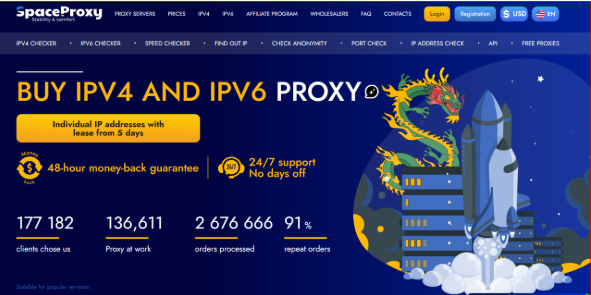
Review scope: pricing and specifications are treated as a provider-published snapshot. Confirm the live checkout and current terms before ordering. Long-term performance figures are not claimed unless independently measured.
Official service: SpaceProxy official English website
SpaceProxy is easy to notice because the entry pricing is low, but inexpensive proxies are only a good business purchase when they reduce friction rather than create it. For this review I looked at the service as if I were running a small agency or operations team that needs proxies every day for market checks, browser sessions, QA, lightweight automation and regional research. The goal was not to chase a headline benchmark. It was to see whether the product structure makes routine work easy to budget, assign and troubleshoot.
The provider publishes fixed IPv4, IPv6 and specialized options together with practical utilities such as proxy, speed, port, anonymity and IP checkers. That combination is useful because daily proxy work includes more than purchasing an address: someone has to validate it, understand the location, record the endpoint, use the correct protocol and replace it when the target workflow changes.
My first task is always inventory, not browsing. I would create a short list of the jobs scheduled for the day and map each one to a proxy type. A marketing analyst checking public regional pages may not need a dedicated address. A browser profile that will stay logged in for a week is a different case. A developer testing IPv6 behavior is different again.
For persistent workflows I would choose individual IPv4 because the endpoint is assigned to one customer and is easier to reason about. Shared IPv4 is useful when the job is disposable, public and price-sensitive. IPv6 is attractive for test environments and compatible sites because the cost can be very low. The mistake would be mixing these categories simply because they all appear in the same dashboard.
The practical value of a cheap proxy is determined by three checks: does it authenticate reliably, does the apparent location match the task, and does the target website behave normally? I would run those checks as soon as the proxy is delivered. A generic IP checker can confirm the exit address, but it cannot tell you whether your actual destination accepts that IP or whether the site's regional logic behaves the way your business expects.
For routine work I keep one test URL per project and one fallback validation URL. When something fails, that makes it easier to determine whether the problem is the proxy, the target or the application. SpaceProxy's supporting checker tools are helpful in this process, but they should complement target-specific testing rather than replace it.
Proxy type | 5 days | 30 days | 90 days | 360 days |
IPv4 Shared | $0.67 | $0.99 | $2.97 | $11.88 |
Individual IPv4 (1-20) | $0.96 | $1.77 | $5.31 | $21.24 |
IPv6 /32 (1-99) | $0.10 | $0.51 | $1.53 | $6.12 |
MTProto (1-20) | $0.96 | $1.77 | $5.31 | $21.24 |
The pricing structure is one of SpaceProxy's strongest practical advantages. Five-day terms allow a team to test a location or workflow without committing to a full month. Longer terms make more sense after the address type and geography have already passed acceptance tests. That supports a sensible buying pattern: short pilot first, larger or longer order second.
Shared IPv4 is priced to favor broad, low-cost access. Individual IPv4 costs more but reduces uncertainty from other customers using the same address. IPv6 is dramatically cheaper, which can be excellent for technical testing but only when the target and software handle IPv6 correctly. MTProto is specialized and should be bought because the application needs it rather than because it is inexpensive.
A common business use is checking how pages appear from another country. This can include language defaults, currency, shipping availability, redirects, cookie banners and localized promotions. For this workload I care about repeatability more than raw speed. I open the page in a clean state, verify the apparent country and record any redirect chain before comparing results from another address in the same market.
This is where inexpensive fixed proxies can be valuable. You do not necessarily need residential rotation for every QA task. A stable fixed endpoint can make comparisons easier because the network identity does not change between page loads. The limitation is that some websites treat hosting-network IPs differently, so results should be validated against the business goal.
Account workflows require more caution. A stable IP can help keep an environment consistent, but the proxy is only one part of the browser fingerprint. Time zone, language, cookies and device settings also matter. I would never rely on the proxy alone to create an identity.
If a browser profile needs continuity, individual IPv4 is the stronger default. Assign the address to one profile, do not share it across unrelated accounts, and document the expiry date. When the rental approaches renewal, decide whether to extend it before the team loses a working session. This simple discipline matters more than buying a large quantity on day one.
For automation, I start small and measure errors by endpoint. A good script records the proxy, target, status code, response time and retry outcome. Without those logs, a team may blame the provider for failures caused by target rate limits or blame the target for a local authentication problem.
SOCKS5 is often useful for software that needs broader connection handling, while HTTP(S) works well for many web-oriented clients. Whatever protocol is selected, it should be standardized across the project. I would also cap concurrency and back off when a target returns rate-limit responses. A low-cost proxy pool does not justify aggressive request behavior.
SpaceProxy promotes checker utilities around the core product. I like that approach because a proxy service becomes easier to operate when validation tools are nearby. A speed checker can provide a quick sanity check, a port checker can help diagnose connection assumptions, and an anonymity/IP check can confirm that the endpoint is being used.
Still, I would not convert those utilities into performance claims. They are diagnostic tools. The real acceptance test is the production workflow, measured over the destinations and locations the team actually uses.
Once a business uses more than a handful of proxies, the problem becomes administrative. I recommend a shared inventory with IP type, country, project owner, renewal date and current status. If an API is used, it should connect to that inventory process rather than sit separately.
A weekly review is enough for many small teams: remove expired endpoints, flag unreliable targets, verify renewals and check whether any dedicated address is being shared accidentally. This keeps the budget predictable and prevents the proxy pool from becoming an unmanaged collection of credentials.
I like the low entry cost, short rental terms, dedicated-versus-shared choice, IPv6 pricing and the presence of supporting check tools. Those features make SpaceProxy approachable for small teams that need practical fixed IP access without a large minimum commitment.
The main cautions are destination compatibility, the reputation uncertainty of shared addresses, IPv6 support and the need to verify location requirements carefully. Low price does not remove those normal fixed-proxy trade-offs.
Yes, especially for public regional checks, QA, browser workflows and compatible automation where fixed IPs are appropriate. The target list should be tested before scaling.
Use shared for lower-cost, lower-risk tasks. Choose individual IPv4 when continuity and exclusive assignment are more important.
A short term is useful for testing a country, software integration or target website before committing to a longer rental.
SpaceProxy makes a convincing case as a low-cost fixed-proxy toolkit for ordinary business workflows. Its strongest advantage is not simply a cheap headline price; it is the ability to start with a small, short pilot and choose between shared IPv4, dedicated IPv4, IPv6 and specialized options. I would recommend it to teams that validate each destination, document assignments and scale only after the exact business workflow proves stable.
Before purchasing, compare the current SpaceProxy pricing and plan details with the workload and location requirements described above.
Final live-check link: SpaceProxy review 2026 - official service
Sat, 24 Oct 2026
Sat, 24 Oct 2026
Sat, 24 Oct 2026

Start learning with Acadomi! Explore thousands of affordable courses on any topic, anytime, and anywhere. Join our community and unlock your potential today!
Leave a comment